Whispers DiTullio
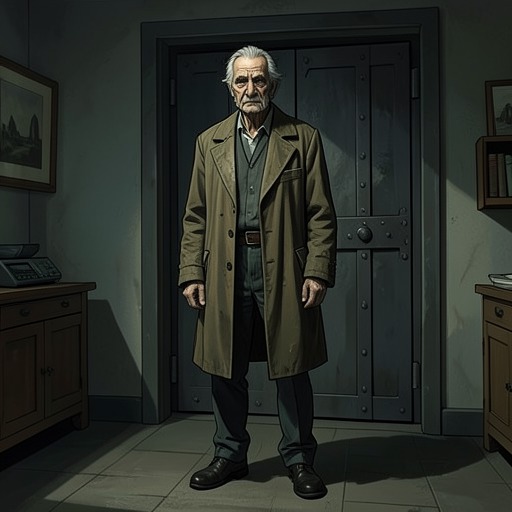
I Heard You Paint HousesWhispers DiTullio is a Philadelphia moneylender whose effort to recover a risky loan turns him from a figure seeking status into the center of a lethal, unresolved episode. He offers Frank Sheeran money to destroy a rival linen service, and the next morning Whispers is found shot on a sidewalk. The narration does not identify his killer, but its sequence of the assignment, a late-night meeting, and Sheeran’s missing .32 makes the silence part of the story.
Identity and Position
Whispers first approaches Sheeran at the Bocce Club, buying him a glass of wine before asking him to meet at the Melrose Diner. Sheeran knows him only slightly, though he knows Whispers lends money on a larger scale than he and his friends do. His loans go to restaurants and legitimate businesses, not merely to waitresses at small roadside restaurants. The choice of the Melrose, described as a place for people grabbing a meal before a Phillies game rather than downtown figures, gives the meeting an ordinary, public setting.
Whispers shares a surname with John DiTullio, known as Skinny Razor, but the two are not related. Sheeran suspects that Whispers wants the name to suggest a connection and raise his standing, making him appear closer to the status of a made man. Yet Whispers’s position remains subordinate: when he sits with John DiTullio and his wife at the Latin Casino, he knows his place and would not speak much. His ambition is legible, but so are the limits imposed by the hierarchy he hopes to approach.
The account makes his whispering a consequence of severe halitosis. His breath is described as so bad that gum and mints cannot help, and people will not tolerate him opening his mouth for long. The physical detail gives his nickname an unglamorous explanation and sharpens the contrast between the status he appears to want and the discomfort he causes in company.
The Linen-Supply Loan
At the Melrose, Whispers asks whether Sheeran can use ten thousand dollars. After they eat, the two walk around the block, where Whispers explains that he has put more money into a linen-supply house than he has ever lent before. The business collects, washes, irons, and delivers linen to restaurants and hotels, a normally lucrative trade that Sheeran likens to a license to print money. In this case, however, the investment is failing.
The company is losing contracts to Cadillac Linen Service, a competitor operating in Delaware. Its available payments cover only the vig, and even those payments sometimes arrive late; Whispers fears that he may lose the principal as well. The trouble is therefore not simply a delayed return. His unusually large stake is exposed, and the rival’s continued success threatens to make recovery take indefinitely long.
Whispers turns that financial pressure into a demand for violence. He gives Sheeran two thousand dollars and tells him to bomb, torch, or otherwise disable Cadillac Linen Service permanently, not merely damage it or cause a temporary interruption. The remaining eight thousand is promised only if Sheeran succeeds in putting the business out of operation for good. Whispers’s objective is explicit: he wants his people to regain the contracts so he can recover his money. His plan treats arson or comparable destruction as a means of settling a commercial dispute, and his remarks about the owners include an antisemitic stereotype.
The Shooting and the Unresolved Account
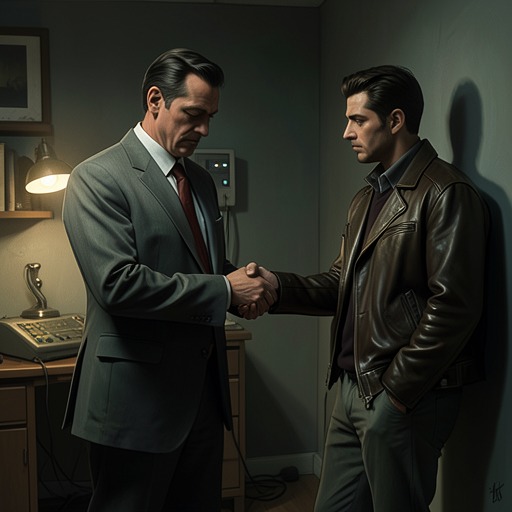
After the assignment, Sheeran says he contacted Whispers and arranged to meet him later that night to discuss the matter. What happened at that meeting is not described. The next morning, according to the newspaper, Whispers is found lying on a sidewalk, shot at close range by an unknown assailant; the report says there were no witnesses. The account’s abrupt movement from a proposed attack on a business to Whispers’s death leaves the relationship between the two events uncertain rather than explaining it.
The weapon detail tightens that uncertainty. Sheeran recalls that a .32 had been given to him by Eddie Rece and says he could no longer find it. He explains that the smaller-caliber gun made less noise than a .38 or .45, though a shot placed correctly could still kill. He does not state that he used it on Whispers. Instead, after reading the news, he sits staring at the paper for more than an hour and thinks that he could have been the one lying there. The missing gun and the thought of his own possible death make the episode ominous, but the narration stops short of naming a killer or confirming what occurred during the night.
Narrative Role
Whispers’s episode begins with a recognizable business calculation: a lender fears losing a large principal because a competitor is taking away contracts. It then exposes the violent logic beneath that calculation, as he offers a sum divided between an advance and payment for permanent destruction. His death follows before the requested outcome is reported, leaving the reader with neither a confirmed account of the job nor a clear explanation of the shooting.
The narration’s concrete details—the apple pie at the diner, the two thousand dollars handed over, the promised eight thousand, the sidewalk, and the untraceable .32—make the account feel specific while preserving its central gap. Whispers is not developed through a full life history; he is defined by his lending, his hunger for standing, his vulnerability to a bad investment, and the lethal request he makes when that investment is threatened. The unresolved ending turns those traits into more than background: the man who tried to secure his money by commissioning destruction disappears from the account as a victim of a shooting whose authorship remains unstated.